
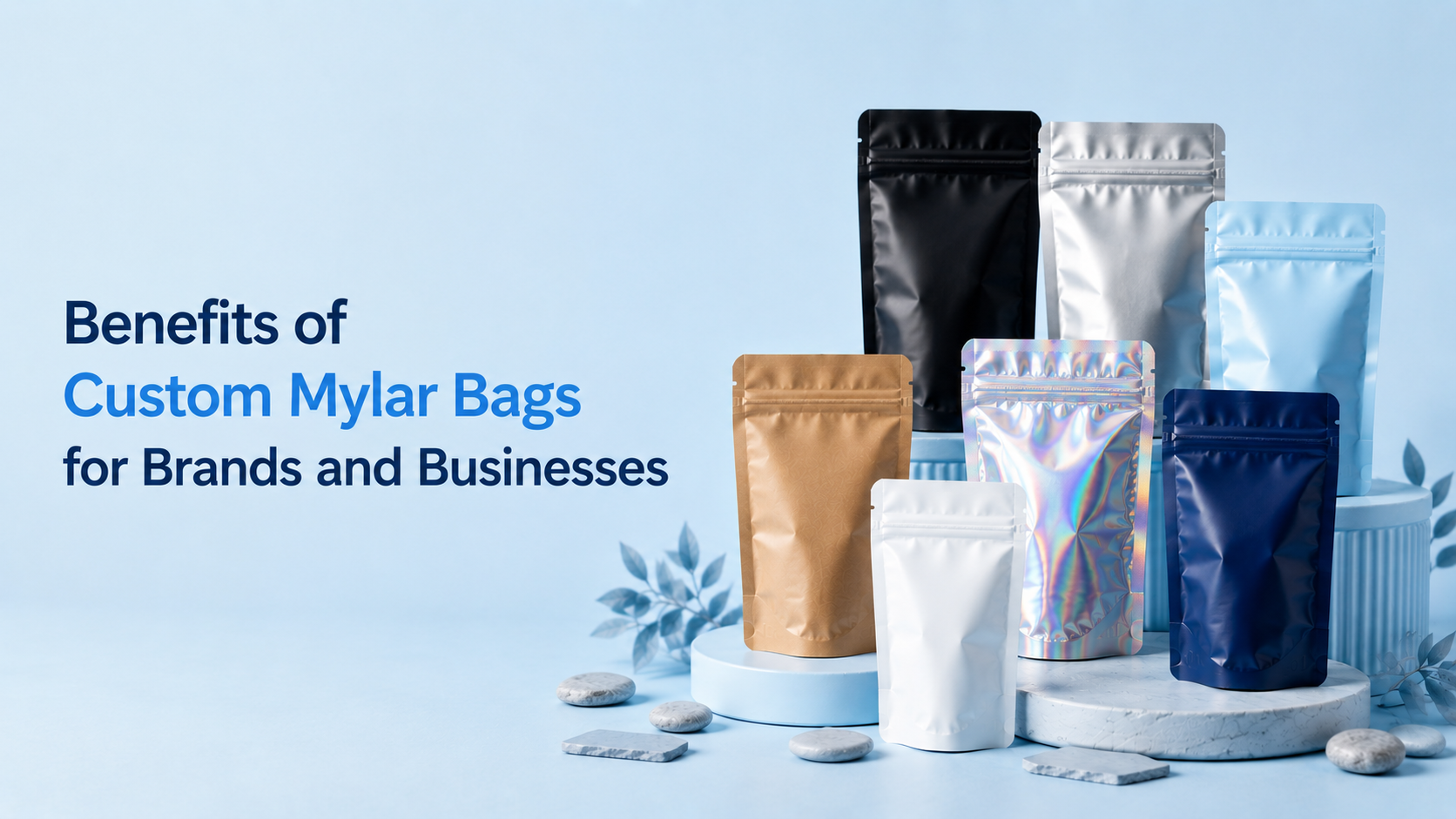
The benefits of custom mylar bags read differently depending on who is asking. A food prepper wants to know how long rice lasts. A brand launching a supplement line wants to know whether the packaging will reduce return rates, survive a distribution warehouse, meet FDA food contact requirements, and look good enough on a retail shelf to justify the price point.
This guide is written for the second person.
Quick Answer: Custom mylar bags benefit brands by extending product shelf life, reducing return rates, lowering shipping costs, ensuring regulatory compliance, and improving retail shelf visibility. Their high barrier performance, measured by oxygen transmission rate (OTR) below 0.1 cc per square meter per day and moisture vapor transmission rate (MVTR) below 0.02 grams per square meter per day, combined with full custom printability, make them the preferred flexible packaging choice for food, cannabis, supplement, and pet treat businesses in the US market.
Why the Benefits of Custom Mylar Bags Matter More in 2026
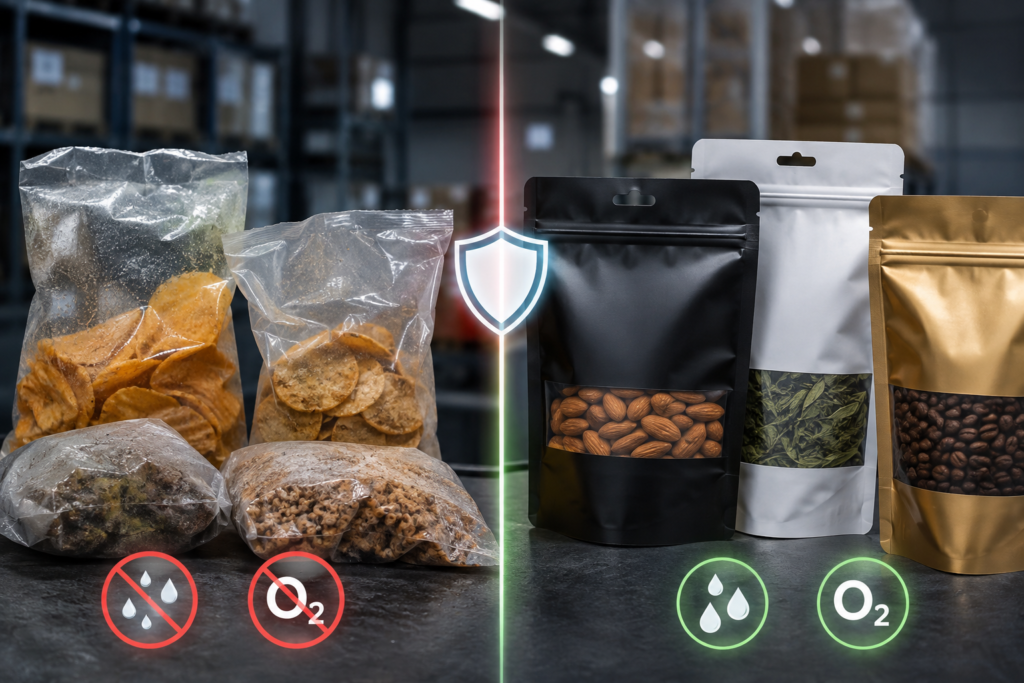
The packaging decision used to be simpler. Pick something that fit the product, looked reasonable, and did not cost too much per unit. That calculation has fundamentally changed.
Google reviews now surface packaging complaints directly on brand search results. Dispensary buyers reject non-compliant packaging at receiving without a second conversation. Ecommerce return rates for food and supplement products are measurably tied to products arriving in degraded condition. The packaging decision is now a commercial decision with consequences that show up in reviews, wholesale relationships, and operating margin.
Mylar bags became the dominant flexible packaging format across food, cannabis, supplements, and pet treats because they solve several of those problems simultaneously. Here is what each benefit actually means in commercial practice.
Who Should Use Custom Mylar Bags
Not every product category needs what mylar delivers. Here is where the benefits are most commercially significant.
Food brands with shelf-life requirements selling through retail, ecommerce, or wholesale channels where products sit in distribution for weeks or months before reaching the end customer.
Cannabis and CBD brands in US legal markets where child-resistant certification under ASTM D3475 is a legal requirement, not an option.
Supplement companies scaling distribution who need barrier-grade flexible packaging that meets FDA food contact compliance under 21 CFR and performs consistently across high-volume fulfillment.
Ecommerce brands reducing return rates where packaging quality during transit is a direct driver of customer satisfaction and review outcomes.
Specialty food and coffee brands where the format and finish of the packaging is doing commercial positioning work on a retail shelf before the customer reads anything on the label.
Benefit 1: Extended Shelf Life That Directly Protects Your Margins
What Barrier Performance Means for Your Bottom Line
In commercial packaging audits, most return-related complaints trace back to incorrect barrier selection rather than product formulation failures. A protein powder that clumps before the customer opens it is not a formulation problem. A cannabis flower that arrives with degraded terpenes and reduced potency is not a cultivation problem. Both are barrier failures that show up in reviews and return rates.
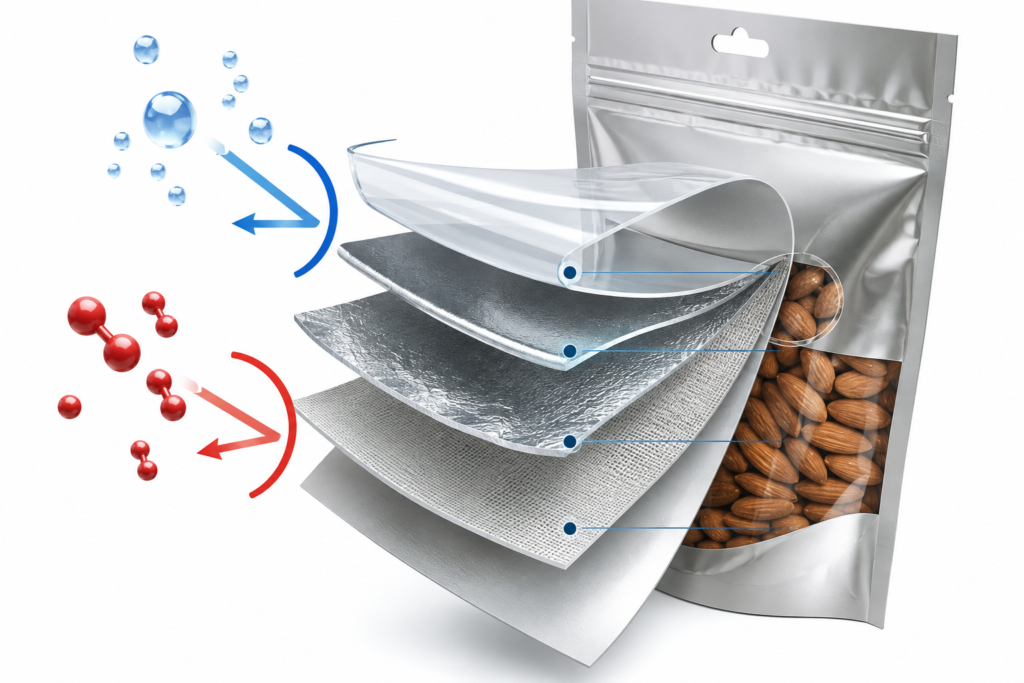
Barrier-grade flexible packaging is defined by two measurable properties. Oxygen transmission rate (OTR) determines how much oxygen passes through the film per day. Moisture vapor transmission rate (MVTR) determines how much moisture moves through the film. A genuine aluminum foil laminate mylar bag delivers OTR below 0.1 cc per square meter per day and MVTR below 0.02 grams per square meter per day. Standard polyethylene film sits at 3,000 to 6,000 cc OTR. That is a performance difference of 30,000 times, which translates directly into shelf life, spoilage rates, and the frequency of quality complaints reaching the customer.
Food-grade mylar bags constructed with a polyethylene inner layer meet FDA food contact compliance requirements. The specific food contact material standards are published under 21 CFR, and any supplier you work with should be able to confirm compliance documentation for the inner layer specification before you place an order.
Benefit 2: Compliance Protection That Keeps Your Wholesale Accounts
Child-Resistant Certification Under ASTM D3475
Cannabis and CBD edibles sold in US legal markets require child-resistant packaging certified under the Poison Prevention Packaging Act, administered by the Consumer Product Safety Commission. The specific testing standard is ASTM D3475, which requires documented third-party laboratory testing, not a supplier’s self-declaration.
Non-compliant packaging is not a fixable problem after you have delivered inventory. It is a reason for the dispensary to reject the entire shipment and source from a compliant supplier. Child-resistant mylar bags with verified ASTM D3475 certification are the minimum viable product for entering a legal cannabis wholesale market. The CPSC publishes the full child-resistant packaging requirements at cpsc.gov.
For food brands, shelf-life stability claims made on product labeling must be supported by packaging that can actually deliver the stated shelf life. Using barrier-grade flexible packaging with documented OTR and MVTR specifications is part of building a defensible food safety position, not just a commercial preference.
Benefit 3: Lower Shipping Costs That Compound at Scale
Flexible Packaging vs. Rigid Alternatives
A glass jar of supplements weighs significantly more than a mylar pouch of the same product. Multiply that weight difference across a pallet of 500 units and the freight cost difference becomes material. Multiply across a year of shipments and it becomes a significant operating line item.
Mylar bags are lightweight, flat when empty, and compress efficiently in storage before filling. Dimensional weight pricing from major carriers means the packaging format directly affects the cost per delivered unit in a way that the purchase price per bag does not capture in isolation.
Stand-up mylar bags deliver preservation performance comparable to glass at a fraction of the shipping weight, with the added commercial benefit of full custom printability on every panel rather than a label applied over a rigid container. For brands shipping 10,000 units per month, the freight differential between flexible and rigid packaging is a genuine strategic advantage, not a marginal one.
Benefit 4: Shelf Presence That Does Commercial Work Before Anyone Reads the Label
Format and Finish as Brand Assets
In retail environments, the bag a brand chooses is doing marketing work independently of the marketing budget. A holographic mylar bag in a dispensary aisle of standard matte black pouches creates visual disruption that pulls attention before the shopper has consciously decided to engage. A kraft-exterior mylar bag in a natural supplement category communicates brand positioning before a word on the label is read.
Kraft mylar bags combine the brand trust signals of kraft paper with the barrier performance of a full aluminum foil laminate interior. The OTR and MVTR performance is identical to standard mylar. The exterior aesthetic is identical to kraft paper. For organic food, herbal supplement, and specialty coffee brands, this format solves the tension between the sustainability aesthetic and the preservation requirement simultaneously.
Full-color printing on custom mylar bags covers front panel, back panel, and bottom gusset. Every square centimeter of that surface is a brand communication asset that glass, tin, and rigid plastic cannot match at the same cost or weight.
Benefit 5: Versatility Across Product Lines Without Changing Suppliers
One Packaging Infrastructure for Multiple Categories
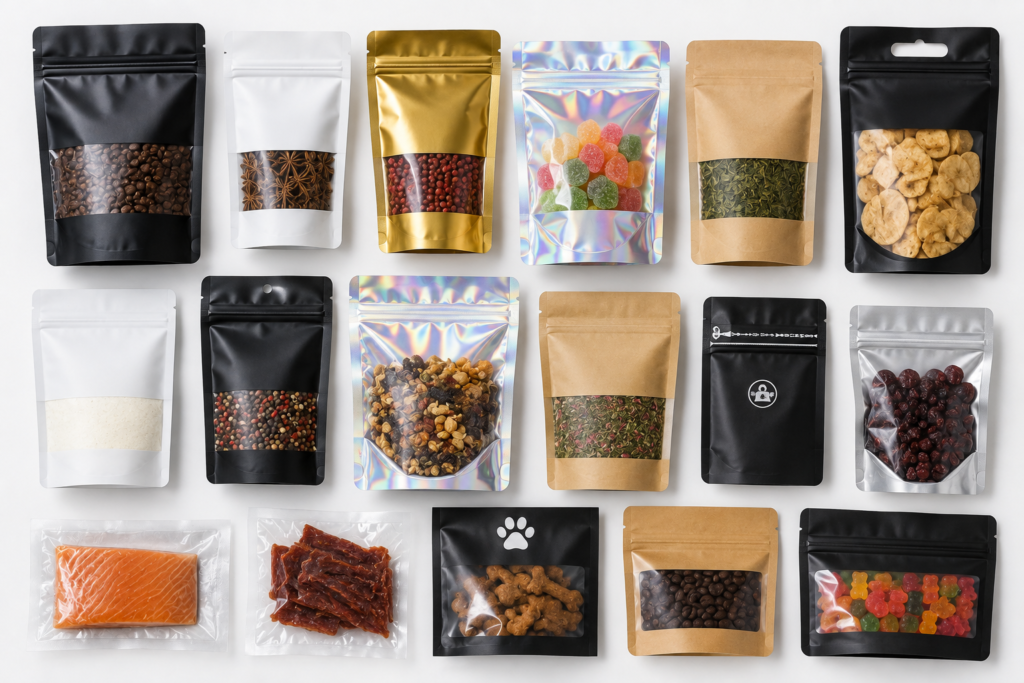
A brand that launches in cannabis and expands into CBD wellness, functional supplements, and specialty food faces a fragmented supplier landscape without packaging infrastructure that scales across categories. Mylar bags cover all of those categories with format and specification variations that do not require rebuilding the supplier relationship from scratch.
Custom weed mylar bags for regulated dispensary markets use the same base film and print technology as food-grade supplement pouches. The compliance specifications differ. The core packaging infrastructure does not. Establishing a mylar bag supplier relationship early creates a platform that supports product line expansion without the lead time and sourcing cost of building new packaging categories for each launch.
Biodegradable mylar bags extend the same versatility into sustainability-positioned product lines, allowing brands to maintain consistent packaging aesthetics while addressing growing consumer demand for reduced environmental impact across their range.
Custom Mylar Bags vs Other Packaging: Quick Comparison
| Format | OTR Barrier | Shipping Weight | Custom Print | Compliance Ready | Cost per Unit |
| Custom Mylar Bag | Excellent | Light | Full color all sides | Yes | Mid |
| Standard Plastic Pouch | Poor | Light | Limited | No | Low |
| Glass Jar | Excellent | Heavy | Label only | No | High |
| Tin Can | Excellent | Heavy | Printed label | No | High |
| Rigid Plastic Container | Low to Medium | Medium | Label or direct | No | Medium |
| Kraft Paper Bag (unlined) | None | Light | Surface only | No | Low |
The core takeaway for brands is that custom mylar bags are the only flexible packaging format that delivers glass and tin level barrier performance at light shipping weight with full custom printability and compliance certification options in a single format.
Get a packaging spec recommendation based on your product category, compliance requirements, and shelf life target. No generic quotes, no vague spec sheets. Talk to our team and get a direct answer within 24 hours.
Frequently Asked Questions About the Benefits of Custom Mylar Bags
Do custom mylar bags actually reduce product returns?
Yes, when the film specification is correctly matched to the product’s barrier requirements. In commercial packaging practice, returns citing clumped powder, stale flavour, degraded potency, or transit damage are overwhelmingly barrier specification failures rather than product failures. A correctly specified mylar bag with verified OTR, MVTR, and appropriate mil thickness eliminates the most common packaging-related failure modes that drive negative reviews and return requests.
Are custom mylar bags worth the cost premium over standard plastic pouches?
For any product with a shelf life requirement beyond a few weeks, or any product in a regulated category requiring compliance certification, the cost premium of mylar over standard plastic is recoverable in reduced spoilage, reduced returns, and avoided compliance liability. The right answer depends on the product’s actual barrier vulnerability and supply chain length, not on the per-unit price difference in isolation.
Can custom mylar bags help my brand pass dispensary compliance review?
Only if they carry verified child-resistant certification to ASTM D3475 standards from a third-party laboratory. Dispensary buyers operate under state compliance frameworks where non-certified packaging is rejected at receiving regardless of product quality. Brands entering legal cannabis markets with documented ASTM D3475 certified child-resistant mylar bags are positioned to pass the compliance review that eliminates non-certified competitors from consideration entirely.
What is the difference between OTR and MVTR in mylar bag specifications?
Oxygen transmission rate (OTR) measures how much oxygen passes through the film per square meter per day. Moisture vapor transmission rate (MVTR) measures how much moisture moves through the film under the same conditions. Both are measured under standardized test conditions and documented in supplier spec sheets. A genuine aluminum foil laminate mylar bag produces OTR below 0.1 cc and MVTR below 0.02 grams per square meter per day. These numbers are the measurable basis for shelf life claims, not marketing language.
Which custom mylar bag format delivers the best retail shelf performance?
Stand-up mylar bags are the dominant retail format because they hold their position on a shelf without support and offer printable surface on front, back, and bottom panels. Flat-bottom bags deliver stronger premium positioning in categories like specialty coffee where the structured base communicates quality before the customer reads the label. Holographic and specialty finish bags create shelf disruption in high-competition categories where visual differentiation at the point of consideration is the commercial priority.
Ready to put these benefits to work? Browse the full custom mylar bag range or get in touch for a direct recommendation based on your product, your market, and your compliance requirements.