
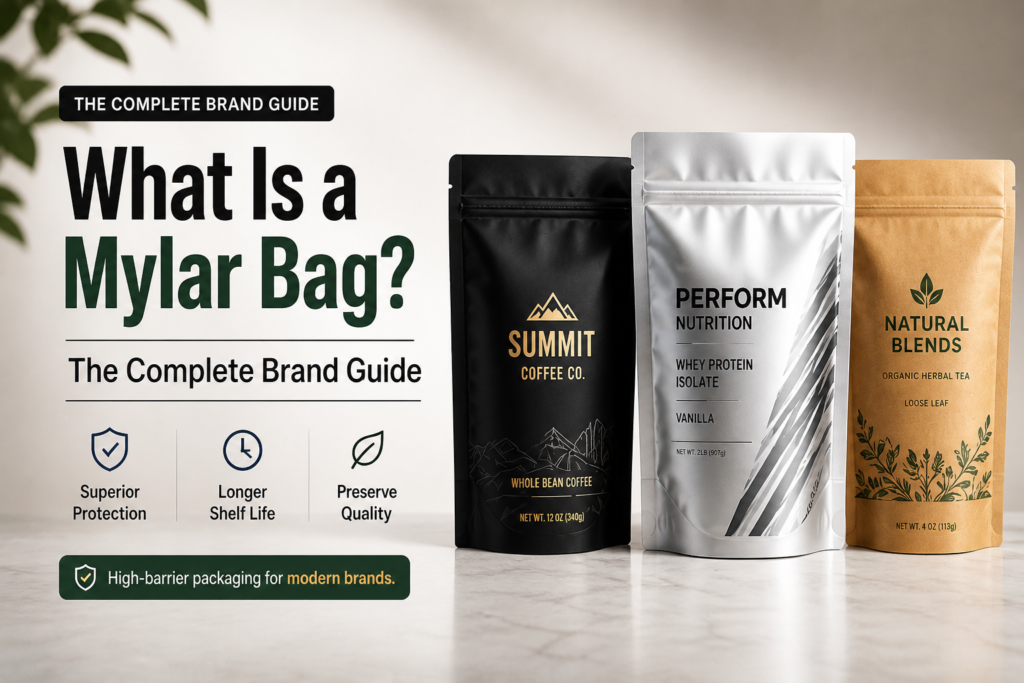
Three years ago, a small coffee roaster out of Portland switched their retail bags from kraft paper to mylar. Not because their designer recommended it. Not because a packaging rep cold-called them. Because their beans were going stale in six weeks and their one-star reviews said so.
Twelve months after the switch, their return customer rate went up. Their refund requests went down. And they stopped hearing the word “stale” entirely.
Packaging did that. Not the roast profile, not the origin story on the label. The bag.
This is what mylar actually does when you stop treating it as a commodity and start understanding what it is made of and why the chemistry works the way it does.
What Is a Mylar Bag
The name is older than most people expect. DuPont developed the underlying polyester film, biaxially-oriented polyethylene terephthalate or BoPET, back in the 1950s. “Mylar” was their trademark for it. The trademark eventually became the generic industry term, the same way people say “Google” when they mean search or “Jacuzzi” when they mean any hot tub.
What you are buying when you order mylar bags is not a single material. It is a laminate system, usually three to four layers, where each layer is doing something the others cannot.
The BoPET core gives the bag its structural integrity. The aluminum foil layer is what makes mylar worth using. The polyethylene inner layer is what makes it safe for food contact and heat-sealable. And in a four-layer structure, the outer printed film is where your brand actually lives.
Strip out the aluminum layer and you have a bag with okay strength but mediocre barrier performance. Keep it, and you have a structure where oxygen transmission drops below 0.1 cc per square meter per day and moisture transmission falls below 0.02 grams per square meter per day. For context, standard polyethylene bags let through roughly 50 times more moisture. That gap is not a marginal improvement. It is a completely different category of preservation.
Why the Numbers on the Spec Sheet Are Not Just Numbers
Most brands skim past oxygen transmission rate and moisture vapor transmission rate when reviewing a supplier’s spec sheet. That is usually where the problems start.
Oxygen Transmission Rate
OTR tells you how much oxygen passes through the film per day under standard conditions. For a mylar bag, this should be below 0.1 cc per square meter per day. For context, that is close to nothing. Coffee starts to go stale the moment roasted beans hit open air. Cannabis flower loses terpene content measurably within weeks of being in the wrong packaging. Supplements oxidize and lose potency. A low OTR number is not a selling point on a data sheet. It is the mechanical explanation for why your product still tastes, smells, and works the way it should when it reaches the end customer.
Moisture Vapor Transmission Rate
MVTR is the moisture equivalent of OTR. High MVTR means moisture is moving through the film, which means your jerky softens, your protein powder clumps, and your cannabis flower either dries out or, in humid climates, develops mold. The aluminum foil layer in a properly constructed mylar bag is what drives MVTR to near zero. A bag without a foil layer, which some suppliers call “mylar-style” or “metallized” without being transparent about the difference, will perform significantly worse on moisture than a true aluminum foil laminate.
Mil Thickness
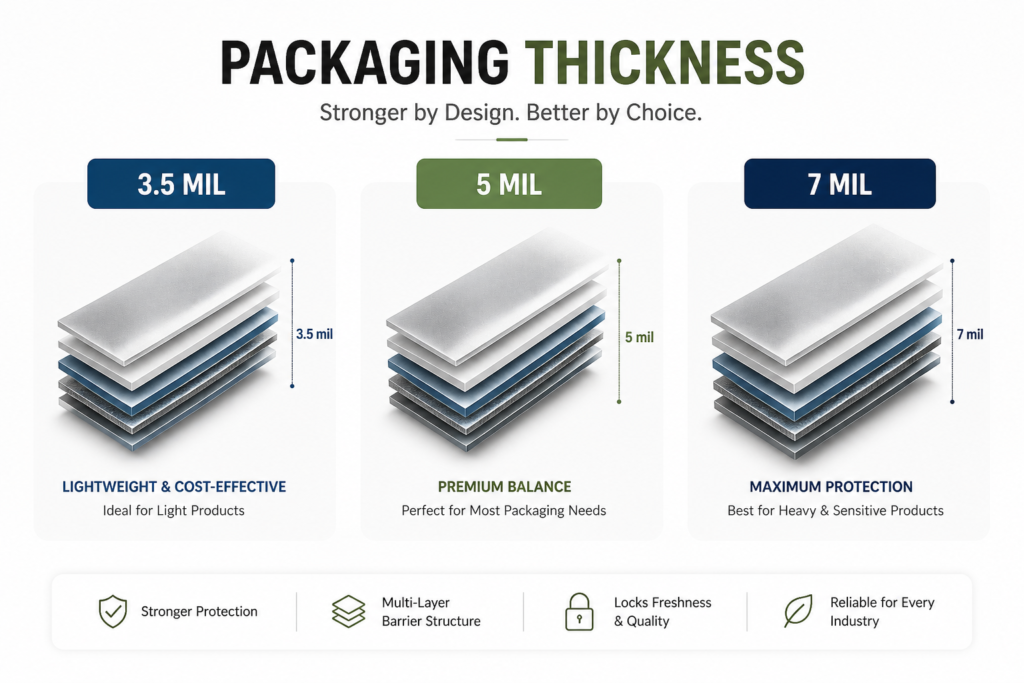
Thickness gets quoted in miles, which are thousandths of an inch. A 3.5 mil bag is fine for lightweight retail products that move through a clean, controlled supply chain. A 5 mil bag handles the majority of food, supplement, and cannabis applications. A 7 mil bag is for anything heavy, sharp-edged, or going through a rough distribution environment. If a supplier quotes you a price but cannot tell you the mil thickness without going to check, you are not getting a straight answer on what you are actually buying.
The Bag Types, and Why the Format Decision Matters as Much as the Film
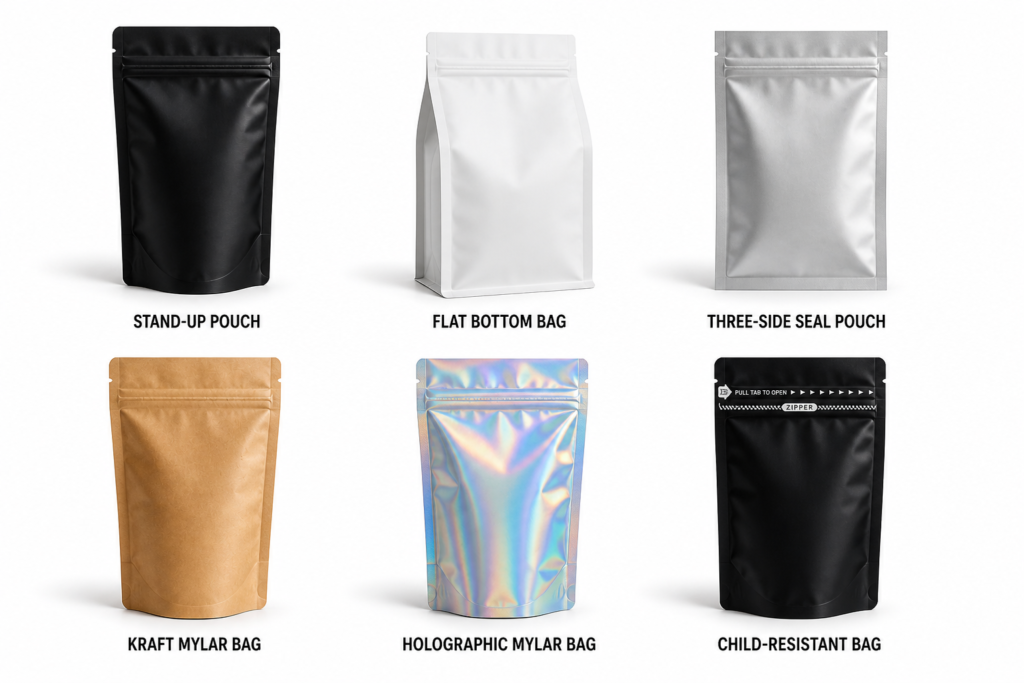
People spend most of their decision-making energy on print and finish. The format choice matters just as much, and it is the one that is hardest to fix after you have received 5,000 units.
Stand-Up Mylar Bags
The bottom gusset is what makes a stand-up bag work. It folds out when the bag is filled, giving it a stable base. The result is a bag that stands on its own on a shelf, displays well in retail fixtures, and gives you a printable surface on the front, back, and bottom panel.
This is the most common format in consumer goods for good reason. Coffee, snacks, supplements, pet treats, cannabis flower and edibles all predominantly use stand-up bags because the shelf presence justifies the slightly higher cost per unit compared to flat bags. If you are starting a consumer product line and have not committed to a format yet, stand-up mylar bags are the default starting point for most categories and most retail contexts.
Flat-Bottom Mylar Bags
The flat-bottom bag looks like a stand-up pouch that went to architecture school. The structured base gives it a rectangular footprint that does not collapse when the bag is half-empty, which is the moment a standard stand-up pouch starts looking sad on the shelf.
Specialty coffee brands are the clearest example of a category that has moved aggressively toward flat-bottom bags. The format reads as premium before anyone touches the bag. That perception matters at the point of purchase, and for products with a higher price point where the packaging needs to justify the cost, the flat-bottom format earns its price premium.
Three-Side Seal Bags
Simple, cost-effective, and not trying to be anything it is not. Three sides are factory-sealed. The open end gets filled and heat-sealed after. No zipper, no gusset, no structure. These are the right answer for samples, single-serve products, sachets, and industrial applications where the bag is a functional container, not a branding vehicle.
Child-Resistant Mylar Bags
This is where packaging becomes a legal matter rather than a brand choice. The Consumer Product Safety Commission requires child-resistant packaging under the Poison Prevention Packaging Act for cannabis, certain pharmaceuticals, and several other regulated product categories. The specific testing standard is ASTM D3475, which measures whether a child under five can open the closure within a set time period while adults can open it without unreasonable difficulty.
Child-resistant mylar bags that meet this standard have a zipper mechanism that requires simultaneous squeeze and slide or squeeze and pull motion to open. The certification is not a design feature. It requires documented third-party testing. If a supplier tells you their bags are “child-resistant” but cannot produce ASTM D3475 test documentation, that claim is not worth the product page it is written on.
The CPSC publishes the full compliance requirements at cpsc.gov. If you are selling cannabis or CBD edibles in any US state with legal dispensary operations, reading that page is not optional. Your dispensary clients already know it. You should too.
Cannabis and Weed Mylar Bags
Cannabis packaging compounds every requirement that applies to food packaging and adds several more. The barrier performance has to protect terpene content and potency through a supply chain that might include a warehouse, a distributor, and a dispensary shelf before anyone opens the bag. The closure has to meet CPSC child-resistant certification. The exterior has to carry state-mandated warning text, THC content disclosures, and in most states must be opaque.
Custom weed mylar bags that are built for regulated markets are not the same as a standard mylar bag with a cannabis logo printed on it. The compliance requirements are structural, not cosmetic. Getting this wrong creates liability for the dispensary you are supplying, which is a fast way to lose an account.
Holographic Mylar Bags
The barrier performance of a holographic mylar bag is the same as a standard mylar bag. The prismatic surface treatment that creates the light-refracting color shift is applied to the outer printed layer. It does not compromise the foil or the PE inner layer.
What it does is create visual disruption on a crowded shelf. In categories like cannabis edibles, supplements, and specialty snacks where dozens of products sit at eye level, holographic mylar bags pull attention before the shopper has decided to engage. That is not a trivial thing when you understand how retail purchase decisions actually work. Most buying decisions start with noticing, not reading.
Kraft Mylar Bags
The kraft exterior is paper. The interior is a full mylar laminate. The barrier performance is identical to standard mylar. The reason brands choose kraft mylar is the aesthetic signal it sends before anyone reads the label.
Organic, natural, artisanal, sustainable. Kraft paper carries those associations culturally in a way that metallic mylar does not. For specialty coffee roasters, herbal supplement brands, and organic snack companies, the kraft exterior justifies itself in positioning before it ever appears in a product review.
Smell-Proof and Vacuum Seal Bags
Smell-proof bags use a reinforced foil layer and tighter zipper tolerances to ensure zero odor transmission. This matters enormously for cannabis brands operating in states where regulations specifically prohibit product odor being detectable from outside the packaging.
Vacuum seal mylar bags go one step further by removing air from the package entirely before sealing, which drops interior oxygen to near zero without relying on oxygen absorbers. Common in specialty coffee, pharmaceutical applications, and high-value food products where even trace oxidation is commercially unacceptable.
At this point you probably have a specific product in mind. If you want to talk through which format and film spec fits what you are selling, our team can turn a 10-minute conversation into a recommendation that saves you from a costly first run in the wrong format.
What Products Are Actually Being Packaged in Mylar
Food and Beverage
Freeze-dried meals are the most extreme example. In a properly sealed mylar bag with oxygen absorbers, freeze-dried food stays shelf-stable for 25 to 30 years. That is not a marketing language. That is the documented result of near-zero oxygen and moisture inside the package.
For everyday food applications like coffee, tea, nuts, dried fruit, jerky, protein powder, and spices, mylar extends shelf life from weeks to months without refrigeration, which reduces spoilage, simplifies logistics, and gives brands more room to sell direct to consumer without worrying about product condition on arrival.
Cannabis and Hemp Products
Flower, pre-rolls, edibles, concentrates. The barrier performance preserves potency and terpene profile. The child-resistant compliance meets legal requirements. The custom print capability lets brands operate at the shelf presence level that the legal cannabis market increasingly demands.
Nutraceuticals and Supplements
Vitamins, powders, capsules, gummies, functional mushrooms. The light and oxygen barrier extends shelf life without refrigeration, which is a genuine cost reduction for brands managing ambient temperature storage and distribution.
Pet Treats and Animal Nutrition
Premium pet food has moved toward mylar because the barrier performance keeps treats fresh without synthetic preservatives, which is a commercially valuable claim in a market where “natural” positioning commands real price premiums.
Mylar Bags Compared to Other Common Packaging Formats
| Format | Oxygen Barrier | Moisture Barrier | Shelf Life | Cost vs Mylar |
| Standard Polyethylene Bag | Poor | Poor | Weeks | Lower |
| Kraft Paper Bag | None | Poor | Days to Weeks | Lower |
| Glass Jar | Excellent | Excellent | Years | Much Higher |
| Tin Can | Excellent | Excellent | Years | Much Higher |
| Mylar Bag | Excellent | Excellent | Months to Years | Mid |
The practical takeaway is that mylar delivers glass-jar or tin-can level preservation at a fraction of the weight and cost, with full custom printability on every surface. For brands that need barrier performance without the logistics cost of glass or metal, mylar is not one option among many. It is the answer.
How to Make the Right Choice Before You Place an Order
Start with What Your Product Actually Needs
Do not open a packaging catalog and pick what looks good. Start by identifying what your product is vulnerable to. High-fat content means oxidation is the primary threat, so OTR is the priority. Hygroscopic powders mean moisture is the problem, so MVTR matters most. A product going through a rough distribution chain needs mil thickness first. Match the film spec to the vulnerability.
Nail the Compliance Requirements Before Anything Else
If your product is regulated, confirm the compliance requirements before you discuss print or format. Ask specifically for ASTM D3475 test documentation for child-resistant bags. Ask for FDA food-contact compliance confirmation for the inner layer. Ask for the specific foil thickness used in the laminate. A supplier that answers these questions confidently and specifically is operating at a different level than one that sends you a catalog PDF.
Get a Physical Sample and Actually Test It
Run the zipper. Fill it with your product. Seal it. Drop it. Shake it. Put it in a warm car for a week. This is not excessive. It is the minimum diligence before committing to a production run. If the seal fails in your kitchen, it will definitely fail in a distribution warehouse.
If you are ready to move past the research phase, request a free quote and we will get back to you within 24 hours with a recommendation specific to your product, your format requirements, and your order volume. No setup fees, no minimum order pressure, and no vague answers about film specs.
What is the actual difference between a mylar bag and a regular plastic bag?
The material structure is completely different. A regular plastic bag is typically a single layer of polyethylene with minimal barrier properties. Oxygen, moisture, and light move through it relatively freely. A mylar bag is a multi-layer laminate with an aluminum foil layer at its core that creates a barrier 50 times stronger than polyethylene on moisture alone. The result is not a marginal difference in performance. It is a categorically different level of preservation that makes long shelf life possible without refrigeration or synthetic preservatives.
How long do mylar bags actually keep food fresh?
The bag alone does not determine shelf life. The combination of the bag, the sealing method, and whether oxygen absorbers are used inside the sealed package determines shelf life. Freeze-dried food in a properly sealed mylar bag with oxygen absorbers reaches 25 to 30 years under the right storage conditions. Dry goods like rice and beans last 5 to 10 years. Coffee, tea, and snacks stay fresh for 12 to 18 months without refrigeration. The bag creates the right environment. The oxygen absorber removes the remaining oxygen inside that environment.
Are mylar bags actually FDA approved for food contact?
The FDA approves materials and compounds, not finished packaging products. What matters is whether the inner contact layer of your specific bag meets FDA food-contact compliance under 21 CFR. The polyethylene or polypropylene inner layer in a properly manufactured mylar bag meets that standard. Ask your supplier to confirm the inner layer specification and its compliance basis in writing before using any bag for food packaging.
Do mylar bags need to be heat sealed or is the zipper enough?
It depends on the application. For retail products where consumers need to reseal after opening, a zipper closure is designed for exactly that use. For long-term food storage or any application where maximum barrier integrity is the priority, heat sealing creates a more complete airtight closure than a zipper alone. Many brands use both: a heat seal across the top for the initial tamper-evident closure, and a zipper below it for consumer convenience after the bag is first opened.
What does child-resistant certification actually require?
It requires third-party testing, not a supplier’s self-declaration. The CPSC administers child-resistant packaging requirements under the Poison Prevention Packaging Act. The specific test standard is ASTM D3475, which measures the ability of children under five to open the closure within a defined time window while confirming adults can access it without unreasonable difficulty. A bag that has passed this testing will have documentation to prove it. A bag described as “child-resistant” without supporting test documentation is a legal liability, not a compliance solution.
Still working out which bag is right for your product?
Browse the full custom mylar bag rangeor get in touch with our team. We work with brands at every stage, from first product launch to scaling existing lines, and we give straight answers on specs, compliance, and lead times.